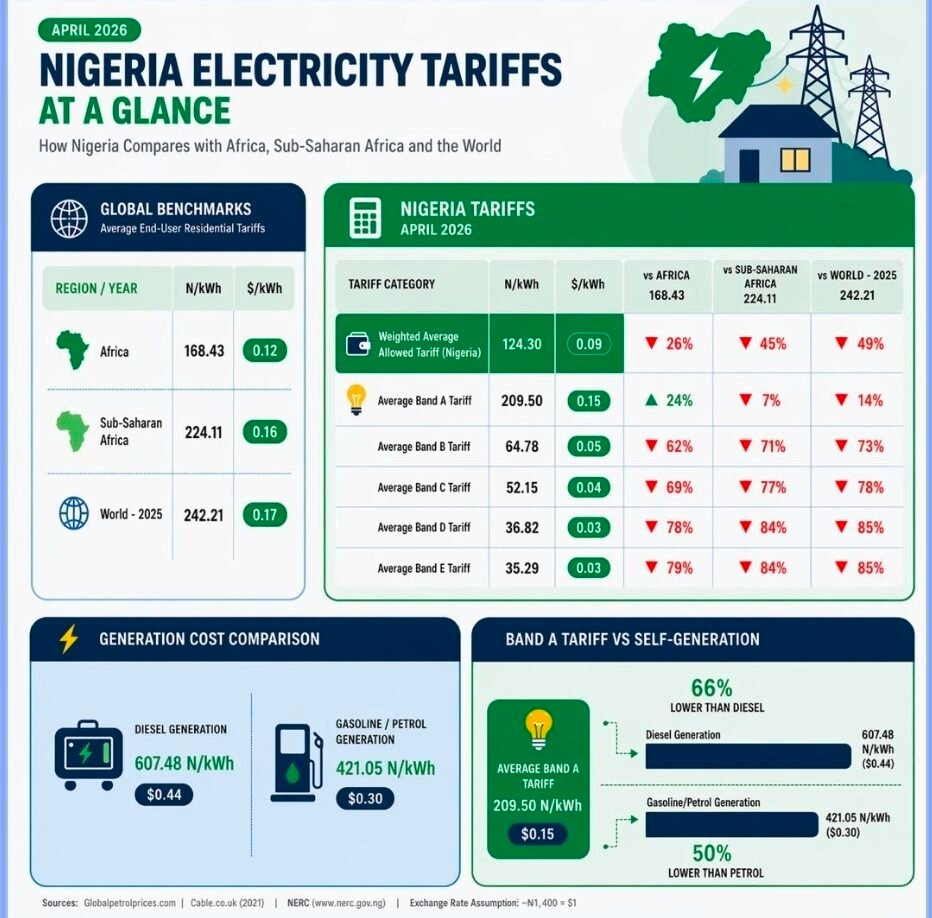
Nigeria’s weighted average electricity tariff sits at just ₦124.30/kWh ($0.09) a figure that sounds like good news until you examine what it has produced. This tariff is 49% below the global average, 45% below Sub-Saharan Africa, and 26% below the African average. Yet Nigerians are not enjoying cheap electricity. They are subsidising a broken grid, and paying the full price elsewhere.
The hidden tax: self-generation
When the grid fails and it does Nigerians turn to alternatives that the tariff data exposes ruthlessly. Diesel generation costs ₦607.48/kWh ($0.44). Petrol generation costs ₦421.05/kWh ($0.30). A Nigerian running a diesel generator is paying nearly five times the weighted average grid tariff for the privilege of keeping their lights on. The pursuit of cheap electricity has created the most expensive electricity on the continent.
The Band A vindication
Critics of tariff reform frequently cite Band A’s ₦209.50/kWh ($0.15) as burdensome. The data flatly contradicts this. Band A is still 7% below Sub-Saharan Africa’s average and 14% below the global average. More compellingly, it is 66% cheaper than diesel and 50% cheaper than petrol. Any Nigerian currently running a generator is already paying far more than Band A and receiving intermittent, unreliable power in return.
What the band structure reveals
Bands D and E the tariff categories serving the poorest Nigerians are priced at just ₦35–37/kWh. These rates are 84–85% below the global average. At this level, no Distribution Company (DisCo) can generate the revenue needed to maintain infrastructure, let alone upgrade it. The result is a self-fulfilling cycle: the lowest-paying customers receive the worst service, reinforcing the very poverty the low tariff was meant to address.
The argument for reform
Artificially suppressed tariffs do not protect vulnerable Nigerians they guarantee that the grid never improves enough to reach them reliably. A cost-reflective tariff structure, paired with targeted subsidies for genuinely low-income households, would unlock private investment, drastically reduce Nigeria’s dependency on the generator economy, and begin to close the gap between what the grid charges and what it costs to actually deliver power.
The numbers make the case with brutal clarity: Nigerians are already paying for electricity just to the wrong system.
Sources: Globalpetrolprices.com · NERC (nerc.gov.ng) · Cable.co.uk (2021) · Exchange rate: ~₦1,400 = $1
-Adetayo Adegbemle is a public opinion commentator/analyst, researcher, and the convener of PowerUpNigeria, an Electric Power Consumer Right Advocacy Group, based in Lagos. (Twitter: @gbemle, @PowerUpNg)