
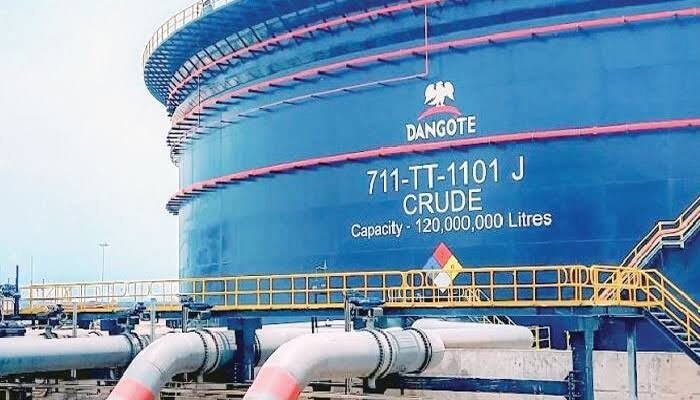
The latest OPEC Monthly Oil Market Report sends a message that policymakers, investors and industry operators in Nigeria should not ignore. While much attention has focused on crude oil prices, a more profound transformation is taking place in the global refining industry one that presents a rare opportunity for Nigeria’s Dangote Petroleum Refinery to establish itself as a major international supplier of refined petroleum products.
The report shows that refining margins are under pressure in two of the world’s traditional refining centres—the United States Gulf Coast and Rotterdam. Higher refinery utilisation, increased product availability and weaker petroleum product prices have squeezed profitability despite strong refinery operations.
In June alone, refining margins on the US Gulf Coast fell for the third consecutive month to an average of $29.35 per barrel, while margins in Rotterdam dropped to $24.25 per barrel. Even though refineries in both regions increased crude processing, stronger output resulted in abundant supplies of gasoline, diesel and aviation fuel, placing downward pressure on margins.
Singapore offered a different story. There, lower crude prices and improved crude availability lifted refining economics despite softer product crack spreads. The lesson is unmistakable: today’s refining industry is no longer driven solely by geography. It increasingly rewards efficiency, flexibility, access to competitive feedstock and the ability to optimise every barrel of crude processed.
This is where Dangote Petroleum Refinery enters the global conversation.
With a nameplate capacity of 650,000 barrels per day, the refinery is among the largest single-train refineries in the world. More importantly, it is one of the newest and most technologically advanced. At a time when many refineries in Europe and North America are ageing, expensive to maintain and increasingly constrained by environmental regulations, newer high-conversion refineries possess an inherent competitive advantage.
The refinery’s ability to maximise production of high-value products such as petrol, diesel and aviation fuel while reducing low-value residual fuel oil positions it well for an increasingly competitive market.
This is no longer simply about meeting Nigeria’s domestic fuel requirements.
The real prize lies in exports.
Africa remains one of the world’s fastest-growing fuel markets, yet many countries continue to depend heavily on imported refined petroleum products. At the same time, Europe is seeking greater supply diversification following years of geopolitical disruptions, while several emerging economies require reliable suppliers of cleaner fuels.
Dangote Refinery has the potential to serve all three markets.
The refinery has already demonstrated its export capability by supplying petroleum products to African countries and shipping cargoes into Europe. If managed efficiently, it could become one of the continent’s largest exporters of refined fuels, generating foreign exchange, strengthening Nigeria’s balance of payments and creating thousands of jobs across the downstream value chain.
However, possessing a world-class refinery is not enough.
Nigeria must ensure that Dangote and other domestic refineries have consistent access to crude oil. Persistent supply bottlenecks, commercial disputes and policy uncertainty could undermine the competitiveness of facilities that should instead be operating at maximum capacity.
Infrastructure remains another challenge.
Pipelines, storage terminals, ports and marine logistics require significant improvement if Nigeria intends to become a regional refining hub. Refining competitiveness is determined not only by processing costs but also by the efficiency of product evacuation and distribution.
Government policy must also remain predictable.
Frequent changes in fiscal policies, foreign exchange management or crude supply arrangements could discourage investment and weaken confidence among international buyers.
The OPEC report also illustrates another important reality. Refiners around the world are responding to tighter margins by improving efficiency rather than reducing operations. Refinery utilisation reached more than 96 per cent in the United States during June, while Europe and Asia also increased throughput despite softer refining economics.
That should serve as an important lesson.
Global competition is intensifying. Countries are investing in more efficient refineries, cleaner fuels and integrated petrochemical complexes. Nigeria cannot afford complacency simply because it now hosts Africa’s largest refinery.
Instead, this should mark the beginning of a broader industrial strategy aimed at transforming the country from an exporter of crude oil into a leading exporter of refined petroleum products and petrochemicals.
The global refining industry is changing.
Older competitive advantages are fading. Newer, more efficient and technologically advanced refineries are assuming greater importance.
Nigeria now possesses one of those refineries.
The challenge is no longer whether Dangote Refinery can compete internationally. The challenge is whether Nigeria can provide the stable policy environment, reliable crude supply, efficient infrastructure and commercial certainty required for the refinery to realise its full global potential.
History offers few moments when global market shifts align so closely with national opportunity.
This is one of them.
Nigeria must seize it.